In this blog I am going to write about myself and my learning in this class.

domingo, 23 de noviembre de 2025

Blog#12 ❤️


 Pick 3 things that you think will stick with you:


Looking back on everything we've done this semester, I am sentimental about all I've learned. At first, it would be more challenging for me to process all this information, especially with the transition between majors and courses. Still, incredibly, I was guided by the teachings of Allan Johnson, Jean Anyon, Shannon Renkly, Katherine Bertolini, Sleeter, Delpit, Kohn, Finn, and Shalaby.


The first thing I took away from this was the article "The Deficit Model and the Asset Model." This article showed me that some teachers focus only on students' weaknesses rather than on what they are capable of doing. We shouldn't focus only on the negative; it's essential to see beyond weaknesses or misbehaviors.      https://drive.google.com/file/d/1djonkMMSGtFywQw-6pYQj3b3SQ1WJCP5/view


Second: "Human poverty is political, not an accident. Poverty is a significant barrier to education, even long before children start school. Economic stress can affect mental health." This quote from Anyon's article has been quite significant for me. I believe politics does affect education. In fact, we can see how special education has been basically eliminated, which is very sad. With effort and dedication, every child could have a good education, but if poverty is present, it affects both parents and children. The lack of jobs, difficulties with racism, and other factors make education almost impossible for a segment of society. https://drive.google.com/file/d/1I4KMQzR-MgwUITsEaQiz7vvoPxQDjOZq/view


Third: The Precious Knowledge video has been very significant for me because it made me understand the importance of knowing our cultures and heritages. The importance of race, and that knowledge is power, even when someone wants to take that power away from us through racism and its laws.


s谩bado, 8 de noviembre de 2025

Blog #11 馃挍馃挌馃挏馃А馃┑馃挋


Queering Our Schools By the editors of Rethinking Schools

RI Laws and Policies

Woke Read Alouds: They, She, He Easy as ABC


Connection: 

The articles “Queering Our Schools,” “The Rhode Island document Safe & Supportive Learning Environments,” and “Woke Read Alouds: They, She, He Easy as ABC” share a clear connection. They all address issues related to gender identity and sexual orientation. They all highlight the importance of this topic, but focus on different aspects, which is what I'd like to explain in this post. The video “Woke Read Alouds: They, She, He Easy as ABC” is quite educational and emphasizes the importance of children feeling comfortable with themselves when called by their name and with the correct pronouns. The person in the video uses the book as a simple reading tool to educate families and young children about the variety of pronouns. This video is an excellent example of curriculum integration at the preschool/elementary level. It has a strong connection to the article “Queering Our Schools,” as both reinforce the value of respecting pronouns. "Queering Our Schools" is an article that emphasizes the need for detailed policies, such as gender-neutral bathrooms, with the philosophical justification of explicit education (like in the video), which goes beyond bullying to address homophobia. Essentially, this article seeks to highlight the problem that many who experience this situation feel excluded. Therefore, schools must go beyond simple "anti-bullying" legislation, which often treats the problem as an individual conflict and overlooks systemic issues like homophobia and sexism. For this reason, this article emphasizes the importance of teachers addressing transgender issues and challenges to the gender binary, ensuring that everyone feels included and supported.It also calls for changes to the curriculum and school forms that use categories like ".dad" or "mom," when "Parent/Family Member" would be a more suitable alternative..

Furthermore, the article "RI Gender" reinforces these messages by establishing the legal and ethical responsibilities that schools have to protect students' rights and affirm their identities. Taken together, these resources highlight that education is not neutral: it is a tool for social justice that can either perpetuate inequality or challenge it. As a future educator, it is my duty to create a classroom where students, regardless of their gender or identity, feel seen, valued, and safe to be themselves.


I asked Gemini to create an image for me featuring a teacher with a book about inclusion and students around, and this is what came out!!


Question to Share:


What does an inclusive classroom look like to you?  I'm curious about this.


lunes, 3 de noviembre de 2025

Blog #10 ❤️❤️

What Is Neurodiversity?

                                                   by  Caroline Miller


Reflection/ Argument. 


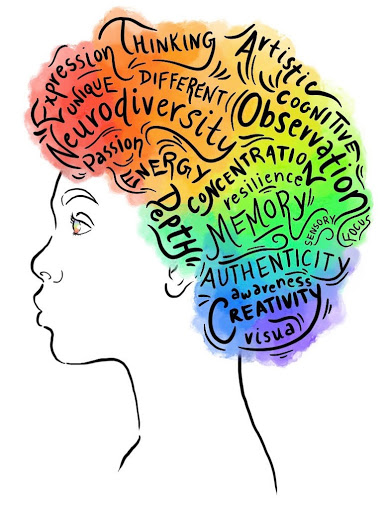
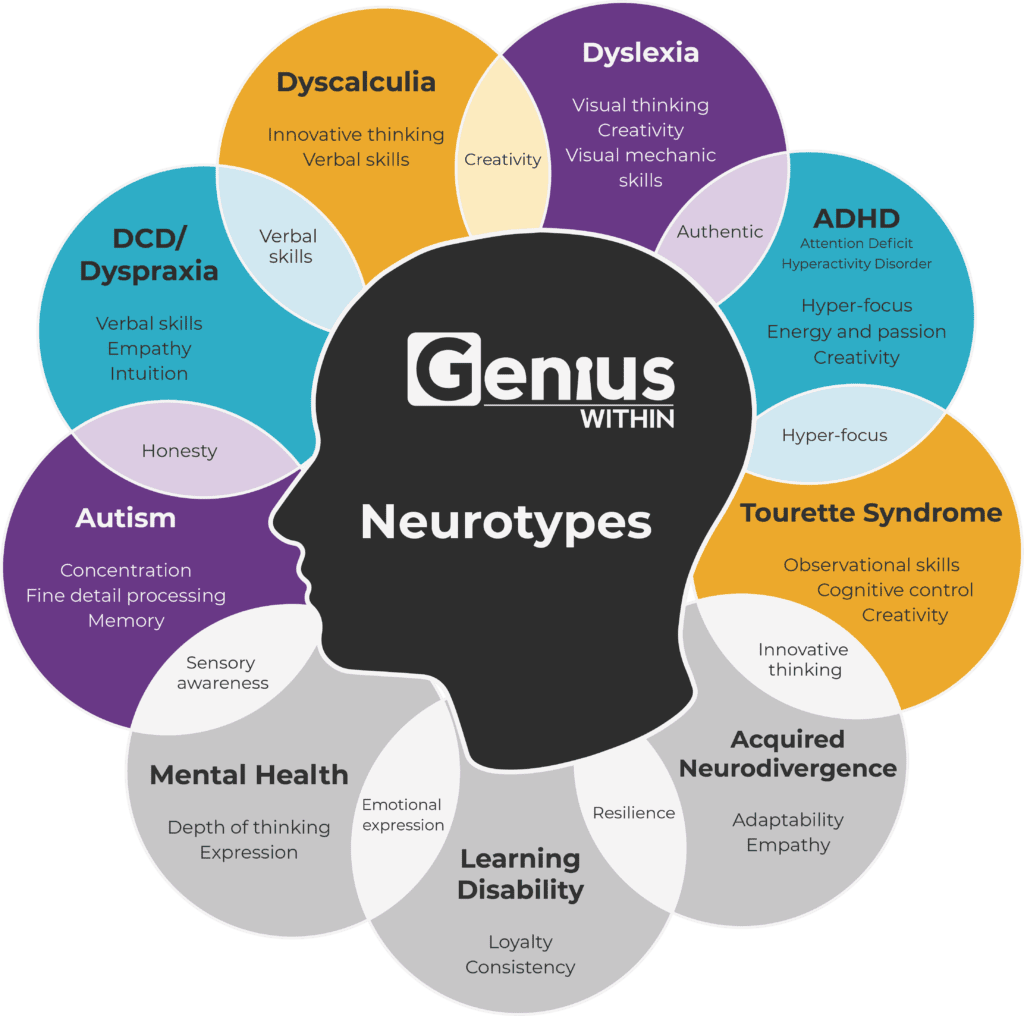
This article was very interesting; I found myself reading it several times and even read it to my mom. In my country, the word ADHD is uncommon; I didn't even know it existed until I came to the United States. My mother and I had a round of discussions and debates on this topic, and we concluded that sociologist Judy Singer was absolutely right when she stated that we need to stop viewing neurological conditions as illnesses that need "fixing" and start seeing them as legitimate human differences that deserve respect and inclusion.

Often in our society, we talk about diversity in terms of culture, race, or gender, but we rarely think about the diversity of the brain, that fundamental part of our frontal head. The article "What Is Neurodiversity?" presents and clarifies an idea that I find powerful: not all brains function the same way, and that doesn't mean there's anything "wrong" with some of them. In fact, psychologist Stephanie Lee explains very clearly that instead of trying to fix someone, we should help them use their natural abilities to achieve their goals. This means we shouldn't just focus on the "deficit" but on that person's abilities, because that's how we give them dignity and autonomy.

Another point that I found very important was that neurodiversity has become an identity for many young people. This means that if they identify as neurodivergent, they can be helped to better understand themselves and feel included (not excluded). While it's clear that professional evaluations by experts are important to provide appropriate support, and I believe this is crucial since, as I mentioned before, I myself didn't know what ADHD was, perhaps as a teacher I wouldn't have been able to understand certain attitudes without knowing the term. However, I should clarify that I've been thinking a lot about dyslexia for the past few months. This is because, although I love to write and read, there are some words I mix up while writing, and it's not just once or twice; sometimes it's a whole sentence. I don't think it's very "advanced" dyslexia, but I know it's there, and perhaps I wouldn't have known about it until I moved here and learned about all these medical terms related to the brain. So, this text made me think a lot about how, whether I have dyslexia or not, it doesn't stop the potential I know I have. That's why Judy Singer clarifies that neurodiverse people can demonstrate great creativity, concentration, or unique ways of solving problems.

Finally, this text encourages us to understand the difference between “disorders” and “differences.” Recognizing a diagnosis is important, as it is fundamental to offering help, but it is necessary to understand that neurodiversity teaches us that there is no single correct type of mind, but rather many ways of being and learning. Each person has unique value, and therefore, as future teachers, it is important to build a more just society so that everyone can feel understood and heard.


What is Neurodiversity? The Diverse Ways Our Brains Operate - Mighty Well  Journal


What is Neurodiversity? - Genius Within


Question to Share:

What methods can schools create for a more inclusive environment where all neurodiverse individuals feel valued and supported?


Blog#12 ❤️

   Pick 3 things that you think will stick with you: Looking back on everything we've done this semester, I am sentimental about all I...