Yarlin Blog

In this blog I am going to write about myself and my learning in this class.

domingo, 23 de noviembre de 2025

Blog#12 ❤️


 Pick 3 things that you think will stick with you:


Looking back on everything we've done this semester, I am sentimental about all I've learned. At first, it would be more challenging for me to process all this information, especially with the transition between majors and courses. Still, incredibly, I was guided by the teachings of Allan Johnson, Jean Anyon, Shannon Renkly, Katherine Bertolini, Sleeter, Delpit, Kohn, Finn, and Shalaby.


The first thing I took away from this was the article "The Deficit Model and the Asset Model." This article showed me that some teachers focus only on students' weaknesses rather than on what they are capable of doing. We shouldn't focus only on the negative; it's essential to see beyond weaknesses or misbehaviors.      https://drive.google.com/file/d/1djonkMMSGtFywQw-6pYQj3b3SQ1WJCP5/view


Second: "Human poverty is political, not an accident. Poverty is a significant barrier to education, even long before children start school. Economic stress can affect mental health." This quote from Anyon's article has been quite significant for me. I believe politics does affect education. In fact, we can see how special education has been basically eliminated, which is very sad. With effort and dedication, every child could have a good education, but if poverty is present, it affects both parents and children. The lack of jobs, difficulties with racism, and other factors make education almost impossible for a segment of society. https://drive.google.com/file/d/1I4KMQzR-MgwUITsEaQiz7vvoPxQDjOZq/view


Third: The Precious Knowledge video has been very significant for me because it made me understand the importance of knowing our cultures and heritages. The importance of race, and that knowledge is power, even when someone wants to take that power away from us through racism and its laws.


s谩bado, 8 de noviembre de 2025

Blog #11 馃挍馃挌馃挏馃А馃┑馃挋


Queering Our Schools By the editors of Rethinking Schools

RI Laws and Policies

Woke Read Alouds: They, She, He Easy as ABC


Connection: 

The articles “Queering Our Schools,” “The Rhode Island document Safe & Supportive Learning Environments,” and “Woke Read Alouds: They, She, He Easy as ABC” share a clear connection. They all address issues related to gender identity and sexual orientation. They all highlight the importance of this topic, but focus on different aspects, which is what I'd like to explain in this post. The video “Woke Read Alouds: They, She, He Easy as ABC” is quite educational and emphasizes the importance of children feeling comfortable with themselves when called by their name and with the correct pronouns. The person in the video uses the book as a simple reading tool to educate families and young children about the variety of pronouns. This video is an excellent example of curriculum integration at the preschool/elementary level. It has a strong connection to the article “Queering Our Schools,” as both reinforce the value of respecting pronouns. "Queering Our Schools" is an article that emphasizes the need for detailed policies, such as gender-neutral bathrooms, with the philosophical justification of explicit education (like in the video), which goes beyond bullying to address homophobia. Essentially, this article seeks to highlight the problem that many who experience this situation feel excluded. Therefore, schools must go beyond simple "anti-bullying" legislation, which often treats the problem as an individual conflict and overlooks systemic issues like homophobia and sexism. For this reason, this article emphasizes the importance of teachers addressing transgender issues and challenges to the gender binary, ensuring that everyone feels included and supported.It also calls for changes to the curriculum and school forms that use categories like ".dad" or "mom," when "Parent/Family Member" would be a more suitable alternative..

Furthermore, the article "RI Gender" reinforces these messages by establishing the legal and ethical responsibilities that schools have to protect students' rights and affirm their identities. Taken together, these resources highlight that education is not neutral: it is a tool for social justice that can either perpetuate inequality or challenge it. As a future educator, it is my duty to create a classroom where students, regardless of their gender or identity, feel seen, valued, and safe to be themselves.


I asked Gemini to create an image for me featuring a teacher with a book about inclusion and students around, and this is what came out!!


Question to Share:


What does an inclusive classroom look like to you?  I'm curious about this.


lunes, 3 de noviembre de 2025

Blog #10 ❤️❤️

What Is Neurodiversity?

                                                   by  Caroline Miller


Reflection/ Argument. 


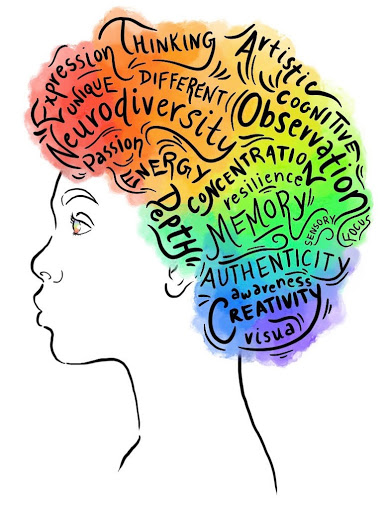
This article was very interesting; I found myself reading it several times and even read it to my mom. In my country, the word ADHD is uncommon; I didn't even know it existed until I came to the United States. My mother and I had a round of discussions and debates on this topic, and we concluded that sociologist Judy Singer was absolutely right when she stated that we need to stop viewing neurological conditions as illnesses that need "fixing" and start seeing them as legitimate human differences that deserve respect and inclusion.

Often in our society, we talk about diversity in terms of culture, race, or gender, but we rarely think about the diversity of the brain, that fundamental part of our frontal head. The article "What Is Neurodiversity?" presents and clarifies an idea that I find powerful: not all brains function the same way, and that doesn't mean there's anything "wrong" with some of them. In fact, psychologist Stephanie Lee explains very clearly that instead of trying to fix someone, we should help them use their natural abilities to achieve their goals. This means we shouldn't just focus on the "deficit" but on that person's abilities, because that's how we give them dignity and autonomy.

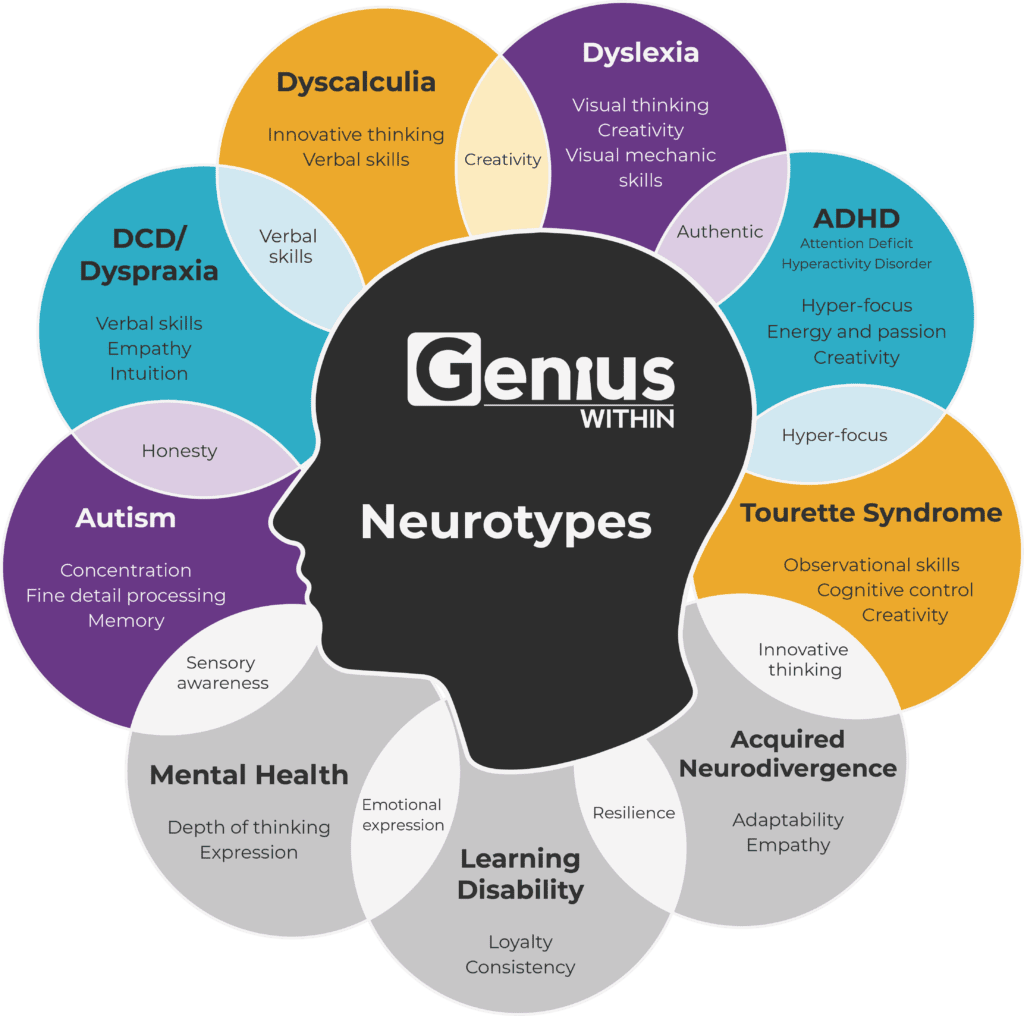
Another point that I found very important was that neurodiversity has become an identity for many young people. This means that if they identify as neurodivergent, they can be helped to better understand themselves and feel included (not excluded). While it's clear that professional evaluations by experts are important to provide appropriate support, and I believe this is crucial since, as I mentioned before, I myself didn't know what ADHD was, perhaps as a teacher I wouldn't have been able to understand certain attitudes without knowing the term. However, I should clarify that I've been thinking a lot about dyslexia for the past few months. This is because, although I love to write and read, there are some words I mix up while writing, and it's not just once or twice; sometimes it's a whole sentence. I don't think it's very "advanced" dyslexia, but I know it's there, and perhaps I wouldn't have known about it until I moved here and learned about all these medical terms related to the brain. So, this text made me think a lot about how, whether I have dyslexia or not, it doesn't stop the potential I know I have. That's why Judy Singer clarifies that neurodiverse people can demonstrate great creativity, concentration, or unique ways of solving problems.

Finally, this text encourages us to understand the difference between “disorders” and “differences.” Recognizing a diagnosis is important, as it is fundamental to offering help, but it is necessary to understand that neurodiversity teaches us that there is no single correct type of mind, but rather many ways of being and learning. Each person has unique value, and therefore, as future teachers, it is important to build a more just society so that everyone can feel understood and heard.


What is Neurodiversity? The Diverse Ways Our Brains Operate - Mighty Well  Journal


What is Neurodiversity? - Genius Within


Question to Share:

What methods can schools create for a more inclusive environment where all neurodiverse individuals feel valued and supported?


jueves, 23 de octubre de 2025

Blog #9

  TroubleMakers by  Shalaby.


Reflection:


    I really liked this article because I strongly identified with words like "problematic," "behavioral," and "challenging," among others. But there's one word in particular that made me wonder: What is good here?     I'm really drawn to the metaphor Shalaby is using here about "the canaries in the mine." Now that I look back at what she wrote, I realize that the school system tends to move quickly to label a student instead of trying to get to know them. In this canary metaphor, the author's most precise meaning was that a "problematic" student's behavior is rooted in something wrong with the school environment. But what's really bad? The answer is to jump to conclusions without trying to understand the most crucial equation: their life outside of school.     I remember a time when I was in 11th grade and I heard the words "misbehavior and attention deficit disorder" for the first time. I've always been a hard-working person with straight A's and was at the top of my class, but two years after finishing high school, my mother decided to transfer me from a private school to a public school, and everything fell apart. While attending the private school, I received more attention from the teachers, had less homework, and participated in a greater number of activities. The classes were smaller, and more resources were available, including a photocopier, a library, and playground equipment. At the public school, it was the complete opposite. The teachers were harsher, the assignments were endless, and it seemed like they only cared about completing the tasks instead of truly understanding the context. There were no copy machines; I had to go in at 7 a.m. and often leave until 5 p.m., and I barely felt like I had time for my social life. So my academic life began to crumble, and with it, my desire to study. I had numerous meetings with the school psychologist about my poor grades and indifferent behavior, and it seemed I was to blame for all of it. My mother was disappointed by my lack of interest, and everyone in my class saw me as the one who never wanted to participate or was always behind on assignments or projects. Behind all of this was a 16-year-old girl trying to deal with family issues, financial struggles because my new school didn't have enough resources to prepare my books on time or print my assignments, and, finally, a problem of adapting. It was tough for me to get out of that hole until I decided to take a music class, as an education and civics teacher was concerned about me and advised me to try something different. With that came band competitions, as well as my interest in musical notes. In less than a year, I had learned to play three instruments, and with that, my motivation returned. That teacher became almost like a mother to me. She believed in me and taught me the phrase, "It doesn't matter if you're doing it right or wrong. The important thing is that you're doing it, and that counts a lot." This reflection by Shalaby, about the children Zora, Lucas, Sean, Marcus, and, of course, Anthony, is totally illuminating in light of what happened to me years ago in the Dominican Republic. By categorizing some children as "problematic" and demanding they learn to obey without question, the school system is creating "robot children" of the system instead of creative ones. Ultimately, this author aims to help teachers understand and appreciate that students who challenge the rules enable us to teach with love, freedom, and justice. I hope some of me will do the same.     I'm unsure of the direction I'll take regarding the problems that occur in schools, where some children are pigeonholed as "problematic," but I hope to be fair and look beyond. I would like to listen and really understand what all this behavior is about.


I asked Gemini to create a TroubleMakers design for me, and this is what came out. I love it.


Question to Share:


Do you think problem children are categorized by their race?


jueves, 16 de octubre de 2025

Blog #8


Literacy with an Attitude

Educating Working-Class Children in Their Own Self-Interest by Patrick J. Finn


Argument: 


    I'll begin this argument with a quote from Patrick Finn that I think changes everything: "I was educating these children, not to take charge of their lives, but to take orders." This simple phrase changed everything for me.

    School is the engine of social mobility, but is it truly designed for all of us to thrive? Well, Professor Finn, in his article Literacy with an Attitude, argues that it isn't. He shows us the two divisions between those who have power and those who don't, and how this affects children and education in general. On the one hand, we have domestic education, which is based on "Functional Literacy," essentially training children to be productive and obedient workers, but not to question or transform their reality. On the other hand, there is empowered education, which is based on the concept of "Power Literacy" for upper-class students, where they receive an education that prepares them to lead and make informed decisions. From there, you can see the difference with the other one above. In Chapter Two, Jean Anyon emphasizes that working-class schools are evaluated based on criteria other than critical thinking. This is not a conspiracy but a social inertia that must be broken. The real battle for equity is not only to demand better resources, but also to ensure that everyone has "Literacy with an Attitude," a critical literacy that empowers us to fight for justice and change, not just for a salary. Anyon also clarifies two things that are essential to me in this argument: Working-class children were developing a relationship with the economy, authority, and work that is appropriate preparation for wage labor, a mechanical and routine job. Their capacity for creativity and planning was often ignored or denied, while the dominant theme in middle-class schools was one of possibility.

    Society has indirectly separated education between those with power and those without. Those who are there to be "important" and those who are there to "nod and obey." What is the system really seeking? Equality or inequality disguised as goodwill? Umm. The reality is that they don't want to admit that those who have money or live in a better neighborhood have the opportunity to improve their lives. In contrast, others are relegated to a role in the never-ending cycle of society.

    The teachers' biggest excuse was:  that these children couldn't be taught anything. Their parents don't care about them; they're not interested in them. The best thing we can do for them is keep them busy. The central argument here was that these working-class children didn't have a low IQ; the problem here was that society had given up, and they had plenty of excuses.

    Both Finn and Anyon address this in a real, substantive way, with foundation and evidence.


Question to share:

Is there any solution to this type of functional, or, as I would say, controlled literacy?

jueves, 2 de octubre de 2025

Blog #7


What to Look for in a Classroom

By Alfie Kohn


Reflection: 


    It's incredible that as I read the poster, many images and activities flashed through my mind regarding the different classes I've taken throughout my college years. I've transitioned from traditional classes to more unconventional ones. What Kohn explains about the differences between "Good Signs" and "Possible Reasons to Worry" is as important for us to understand as it is for future teachers.


    Ultimately, it is our responsibility to reconsider whether we want to create a classroom environment that fosters active learning or one that promotes obedience and conformity. Following Kohn's ideas, we must look beyond grades and focus on how the classroom community feels and is built. There is a phrase I really liked from his book: "I was treating students like rows of wide-open bird beaks waiting for worms." This example serves as a poignant reminder that teachers often assume what works for one student will work for all, but that is not always the case.


    In this class, I have not only learned to know myself better, but I am also more aware of what social justice is and how it influences schools. It is truly satisfying to know that there are teachers who genuinely strive to help students learn. Before transferring to Ric, I never considered the possibility that teaching could also be fun, rather than just a systematic act with chairs in rows, blank walls, and a single person speaking (the teacher). At Ric, the teachers I've had so far listen to me; if I don't understand, they try to explain it to me in a way that I can understand. Above all, they make the classes more dynamic, making it impossible for me not to love the process.


    I changed careers six months ago because I genuinely enjoy helping people, so I thought the best way to do so was to start from the bottom as a teacher. However, as I examined the school system, it discouraged me because I don't want to simply teach one assignment and then move on to another without taking a moment to reflect. I wanted and want much more. I want students to learn to relate what I give them to everyday life. As a future Spanish teacher, it is my duty to ensure that students understand that learning a second language is not just about grammar; it's more than that; it's the opportunity to explore thousands of cultures and histories.


    Kohn highlights the distinction between making a difference in our classrooms and around our schools, versus continuing the same practices we employed years ago. He wants us to think about whether we want to be routine teachers or teachers who genuinely make a difference. Maybe the district won't let us change the themes we've had for years, and I'm dreaming too much, but small steps make a difference, just like Ms. Bogad does. She teaches us that even the simplest things, such as a card game, have a valuable lesson behind them.

    I've always heard that the government is terrified of children having imaginations because then they'd realize they could do much more than what's already dictated. So, they create a system where we all stand with our heads down, listening to what our teachers have to say without even forming our own opinions, and that's something we need to change.


Connection:


Alfie Kohn and Introduction to Culturally Relevant Pedagogy advocate or desire a teaching style more focused on the human person and, of course, on the students. Kohn opposes educational systems that like to explore students' natural drive to learn, often considering them simply as "interchangeable vessels" of information, which is quite interesting in my opinion... In contrast, Culturally Relevant Pedagogy offers a significant way to break away from this mentality, emphasizing the importance of recognizing and honoring the diverse cultural backgrounds that each student brings. Here, we see that both ideas go hand in hand.


By fully embracing Culturally Relevant Pedagogy, we can realize Kohn's vision: which is above all about creating schools that not only promote authentic learning, but also support moral growth and awaken intrinsic motivation in students. This foundation is about transforming classrooms into environments where students feel recognized and valued, and that's pretty valuable if you ask me. The connection between teachers is magnificent..


https://www.alfiekohn.org/article/teach-values/

Alfie Kohn - Wikiquote


Top 80 Alfie Kohn Quotes (2025 Update) - QuoteFancy


Question to Share:

After reading this author, I have many questions, but the most important one is: What do you think is most important in a classroom: Continuing with the traditional, almost gray system of controlled grading, or building a community where students learn actively and meaningfully?

Blog#12 ❤️

   Pick 3 things that you think will stick with you: Looking back on everything we've done this semester, I am sentimental about all I...